EU Cyber Resilience Act (CRA) for US Companies: What You Need to Know


November 25, 2026
Note: Legislation changes. This is not legal advice, and I am a technical writer. The sources used for this piece are in the footnotes.
The CRA, or the European Union Cyber Resilience Act, is EU cybersecurity legislation. It intends to secure all “products with digital elements” (more about this shortly) made available within the EU. Like GDPR before it, the CRA applies whether or not the product was created within the EU, so any company making products available within the EU is subject to it.
The CRA is a vast, expansive, important, and seemingly ever-changing piece of legislation. Understanding your current and future responsibilities under the CRA could mean the difference between staying in business or being bankrupted by fines.
Who is affected by the EU Cyber Resilience Act?
Depending on who you are, or what you are, your responsibilities change. Responsibilities in this context mean your ability to be fined. Many discussions at conferences, at least in the open source community, are around safety - how to maintain a project without falling under regulation. For this, we will showcase the same.
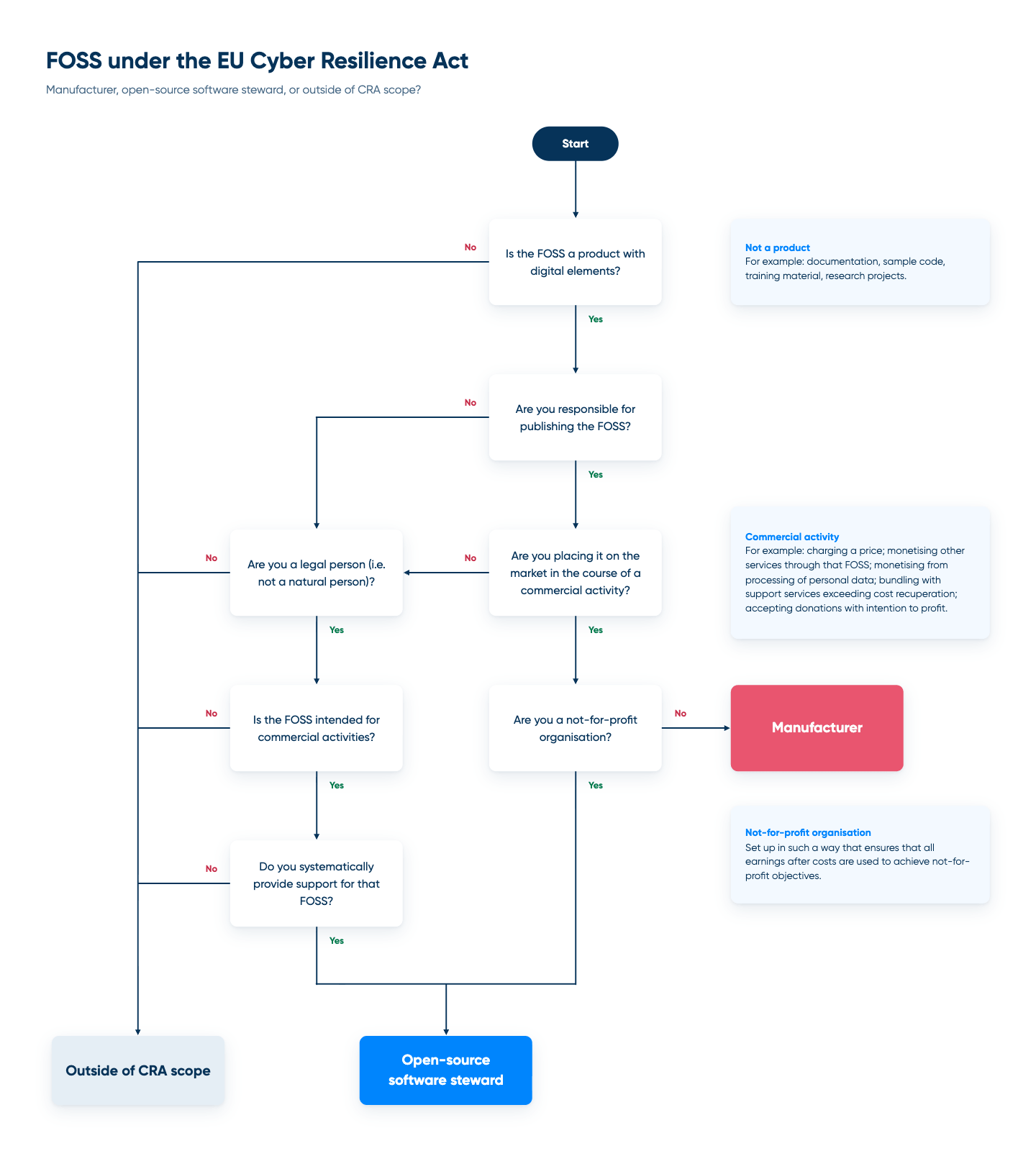
The amount of reporting, fines, and regulation applied depends on the category you fall into. Under the CRA, you can be one of the following:
Natural Person: A human being - a living person.
Legal Person: A legal entity - such as a business entity, or a non-profit. The rights of a legal person will never supersede those of a natural person.
Manufacturer: A natural or legal person who markets or develops a product with digital elements, or has digital elements designed, developed, or manufactured under its name or trademark - whether free, for payment, or monetization.
Open Source Steward: a legal person, other than a manufacturer, who maintains and develops free and open source software intended for commercial activities
Commercial activity is defined as charging a price for a product, technical support, or the intention to monetize. However, accepting donations without the intention of making a profit is not considered commercial activity.
For my fellow open source maintainers - this means if you are working on a CNCF project, or within your own repository, you are a natural person (congratulations!). If you accept donations for that project, that does not count as making a profit, but sustaining life (such as a median salary for the services in your area) rather than making a profit - then you are still a natural person. However, if you make an enterprise edition, market it under a company, or market that software under your own name with the intention of making a profit, you could be seen as a manufacturer.
What products fall under the CRA scope?
The regulation applies to “products with digital elements” (PDE), which is a software or hardware product, including remote data processing, and its separate software and hardware components. This is a deliberately broad definition, ranging from electronic dog toys to open source projects. The CRA requires those selling software to or within the European Union to be responsible for supply chain security. A product with digital elements can be standalone software or a hardware product, but a product delivered only as a Software-as-a-Service (SaaS) platform is not considered a PDE. The important distinction here is about who is managing the product.
Standalone software is software sold to a consumer and runs on their own virtualized cloud, hardware, or otherwise. For example, if I purchase a software subscription for a cloud native service mesh and I install it in production and manage its day-to-day lifecycle, this is considered standalone software.
For SaaS, a consumer purchases a subscription to access services provided by a platform that the selling company produces. For example, if I purchase cloud instances from a third party and run my application on top of them, the cloud instances are being sold to me as a SaaS, and not covered under CRA.
There are three tiers of PDE. The PDE’s class defines whether a manufacturer can conduct their own CRA conformity assessment or if a third party must conduct the conformity assessment. The three tiers are:
1. Important:
- Class I: Identity access management systems, password management, operating systems, internet hardware, smart home products, wearable products
- Class II: Hypervisors and container runtimes, firewalls, tamper-resistant microprocessors and controllers.
2. Critical: Hardware devices with security boxes, smart meter gateways, smart cards, or similar devices
3. Default: Everything Else
The manufacturers of PDEs that fit into the default classification can declare themselves conformant with the CRA by conducting a self-assessment. Important Class I may be able to conduct a self-assessment, or may require a third-party assessment. Important Class II always needs a third-party assessment; Critical needs a European cybersecurity certification.
An important note is that Class I and Class II Free Open Source Software (FOSS) may self-assess if technical documentation for the product is publicly available. Otherwise, a third-party assessment is required. The Critical classification primarily applies to hardware, and if FOSS is integrated into a Critical PDE, then it is on the manufacturer to handle the assessment; there are few (or no) use cases where FOSS would fall into the critical category.
The CRA focuses on eliminating the “I didn’t know” excuse when it comes to leaked private information or vulnerable devices. It places cybersecurity at the forefront for anyone monetizing, or attempting to monetize, software and hardware within the EU.
Why was the CRA enacted?
The European Parliament adopted the CRA in October 2024, with reporting obligations beginning in September 2026 and most obligations beginning in December 2027. The CRA responds to an “inadequate level of cybersecurity” in many products in the EU and aims to implement standards and restrictions to ensure the safety of products sold within the EU. If you’re wondering why cybersecurity is a big deal in the EU, check out what's been happening with grocery store fridges.
Mandatory CRA vulnerability reporting for manufacturers (Article 14 deadlines)
Article 14: Mandatory vulnerability reporting requirements
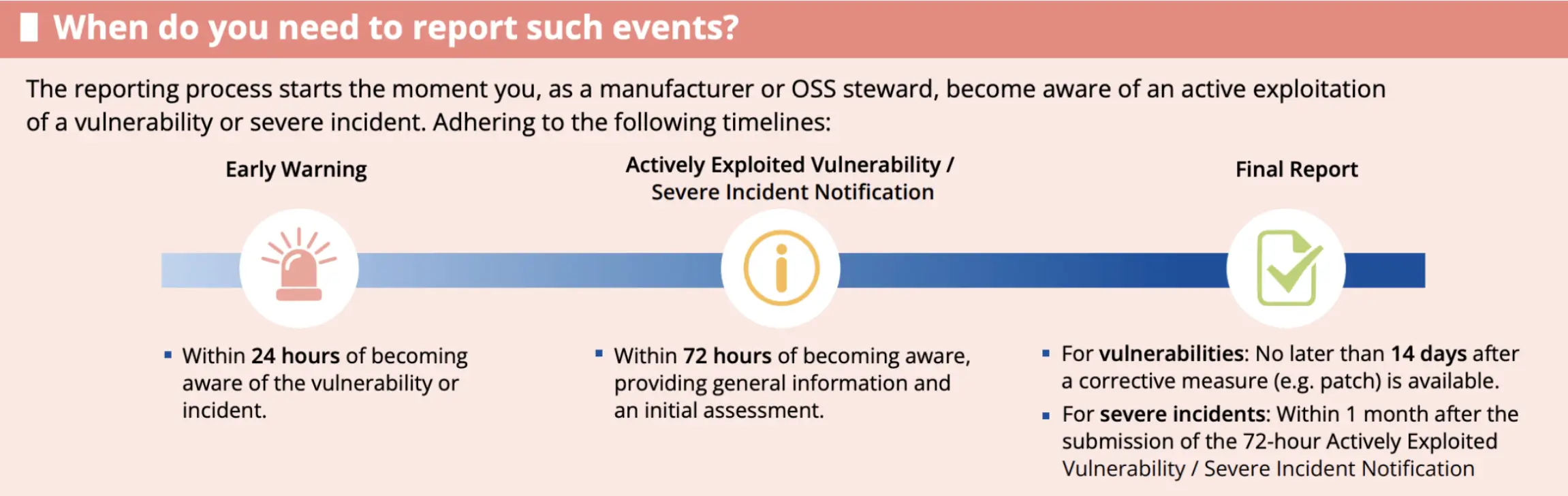
CRA Article 14 has been in effect since September 2026, meaning that manufacturers - and only manufacturers - must report actively exploited vulnerabilities (AEV) and severe-level incidents to the EU Single Reporting Platform (SRP). AEV is a vulnerability for which there is reliable evidence that the vulnerability has been exploited.
- Within 24 hours of becoming aware of an incident, the manufacturer must report it.
- Within 72 hours of becoming aware of an incident, the manufacturer must provide the nature of the exploit, what corrective measures are being taken, and what actions the users can take
- Within 14 days of mitigating or corrective measures becoming available for the incident, the manufacturer must provide a final report that includes a description of the vulnerability of the incident, the impact, any information leaked, and what has been done to remedy the vulnerability.
This reporting is necessary for any standalone software placed on the market before 11 December 2027. If the product was placed on the market before that date, “manufacturers are required to notify the vulnerability or incident, but not required by the CRA to comply with other obligations”. For example, if you sell an enterprise version of an open source product that therefore monetizes that open source product, as a manufacturer you are required to report vulnerabilities in versions placed on the market before 11 December 2027. But if you release new versions of this software after 11 December 2027, you will need to take corrective measures to deep dive, document, and remedy the exploit.
Luckily for all of us, this reporting requirement only applies to new, active vulnerabilities discovered after 11 September 2026. Vulnerabilities a manufacturer was aware of before this date do not need to be reported, unless they were a vulnerability that transitioned into being actively exploited after the date.
Articles to be enacted December 2027

There are a slew of articles (Articles 18 to 23, Article 28, Article 30(1) to (4), Article 31(1) to (4), Article 32(1), (2) and (3), Article 33(5), and Articles 39, 41, 47, 49 and 53) which impose fines later on. A high-level overview:
Articles 18 - 23: Focuses on supply chain roles, such as importers, distributors, and authorized representatives. It places responsibility on importers and distributors to check that products have the proper CE marking and documentation, and ensure the products being imported or distributed by them are identified as in compliance.
Article 28: Manufacturers must create an “EU declaration of conformity” stating it meets the essential cybersecurity requirements
Articles 30-32: Set rules for the CE marking, which you may have seen on other European products or beer glasses, requiring manufacturers to have a cybersecurity risk assessment, and require support measures for different sizes of enterprises.
Articles 39, 41, 47, 49: For active incidents reported under Article 14, these set the conditions for notifying bodies, operational obligations, and what work should be done by them.
Article 53: All those who are part of the supply chain (importers, distributors, authorized representatives) must comply with authorities' access to the product.
Fines for manufacturer non-compliance
EU member states are to create rules and penalties for those who infringe upon the CRA. However, administrative fines for non-compliance set out in Article 14 go up to €15 million, or up to 2.5% of manufacturers' annual worldwide turnover, whichever is higher. For the articles being enacted in December 2027, fines go up to €10 million, or up to 2% of a manufacturer's annual worldwide turnover, whichever is higher. If a manufacturer is caught providing incorrect or misleading information, they will be subject to administrative fines up to €5 million.
Again, these administrative fees are separate from the ones that each EU member state (27, as of this article) is able to impose.
CRA compliance guidelines for US companies marketing software in Europe
The CRA applies to any company selling PDEs within Europe, no matter where that company is located. For Buoyant and many others, this means consulting with European-based CRA legal personnel to see what we need to do to maintain compliance, and creating runbooks for whenever an AEV unfortunately does occur. If you, or a beloved business entity, is selling software or hardware to Europe, it’s best you do the same. Or else, face the multi-million euro fines, which do not include the cost of converting from dollars to euros.
What should you do now? Next steps for CRA compliance & risk mitigation
Identify which classification you fall under. If you’re a manufacturer, then find an EU-based CRA legal representative, as this is still being implemented and can evolve over time. I’ve found it helpful to understand the CRA as putting responsibility on those managing and deploying the software, as well as those creating the software. When reading about CRA, try to keep those verbs in mind to understand what responsibilities you may have – and be aware that there is still one proposal in progress for the CRA at the time of this writing.
The goal of the CRA is to protect consumers and hold entities or persons accountable for disclosing and fixing security vulnerabilities. This may be tedious, expensive, and confusing - however, it forces manufacturers to stop taking the path of least resistance.
FAQ
Does the EU Cyber Resilience Act apply to US companies?
Yes. The CRA applies to products with digital elements placed on the EU market, regardless of where the manufacturer or other economic operator is established. If you sell software or hardware into the EU, you are generally in scope, subject to the CRA’s exemptions. See For US Companies Marketing Within Europe.
Is SaaS covered by the CRA?
Standalone SaaS is not itself a “product with digital elements.” However, remote data processing is covered when it is designed or developed by, or under the responsibility of, the manufacturer and is necessary for the product to perform one of its functions. Thus, SaaS components integrated with an in-scope product can be covered. The decisive test is the CRA’s definition of a product and remote data processing, not simply who operates the service. See The What, including the default, important, and critical product categories.
What must manufacturers report under Article 14, and when?
Since 11 September 2026, manufacturers must report actively exploited vulnerabilities and severe security incidents affecting their products to ENISA and the competent CSIRT through the EU Single Reporting Platform. They must submit an early warning within 24 hours, a fuller notification within 72 hours, and a final report within 14 days after a corrective or mitigating measure becomes available for a vulnerability—or within one month of the 72-hour notification for a severe incident. This includes products already on the EU market. See Reporting for Manufacturers.
What are the fines for non-compliance?
The highest fines can reach €15 million or 2.5% of total worldwide annual turnover, whichever is higher, for the most serious breaches. Other infringement categories carry maximum fines of €10 million or 2%, and €5 million or 1.5%, depending on the obligation. These fines apply from 11 December 2027, when the CRA’s main obligations take effect. See Fines For Manufacturer Non-Compliance.