


Introducing Kinference


November 4, 2026
Today we’re launching Kinference [kay-inference], a new open source project for building scalable inference platforms on Kubernetes. For over a decade, we’ve helped companies build mission-critical Kubernetes systems with Linkerd, and Kinference translates this experience and hard-won lessons to the world of LLM inference.

We created Kinference after watching our customers struggle to run open weight models in their environments (and later, from our own struggles). We were all encountering the same challenge: it was difficult to take a truly platform-centric approach to distributed inference. As we explored the ecosystem, we realized that while there were plenty of projects focused on serving individual models or optimizing performance across a bank of GPUs, there was nothing focused on building an inference platform.
This was surprising. The concept of a platform is central to how this industry has developed scalable and maintainable software for decades, and you need a control plane to build one! And inference is not special in this regard. A platform is, at its core, a layer that mediates access to a shared, precious resource to a set of distinct and sometimes competing consumers, serving each while ensuring fairness, availability, and security. LLM inference fits this model exactly: you have a limited set of all-too-precious GPUs; and you need to provide shared access to the agents, harnesses, and other “intelligent” applications that all want to use them. An inference platform, then, must mediate between these two (ever-changing) sides, providing maximum flexibility to clients while preserving the availability and reliability of the system as a whole.
We designed Kinference to be the control plane that platform. It runs on top of inference engines like vLLM, and provides the set of features necessary for building an inference platform in practice. This includes token rate limiting, tenant usage and cost tracking, intelligent load balancing, and inference policies.
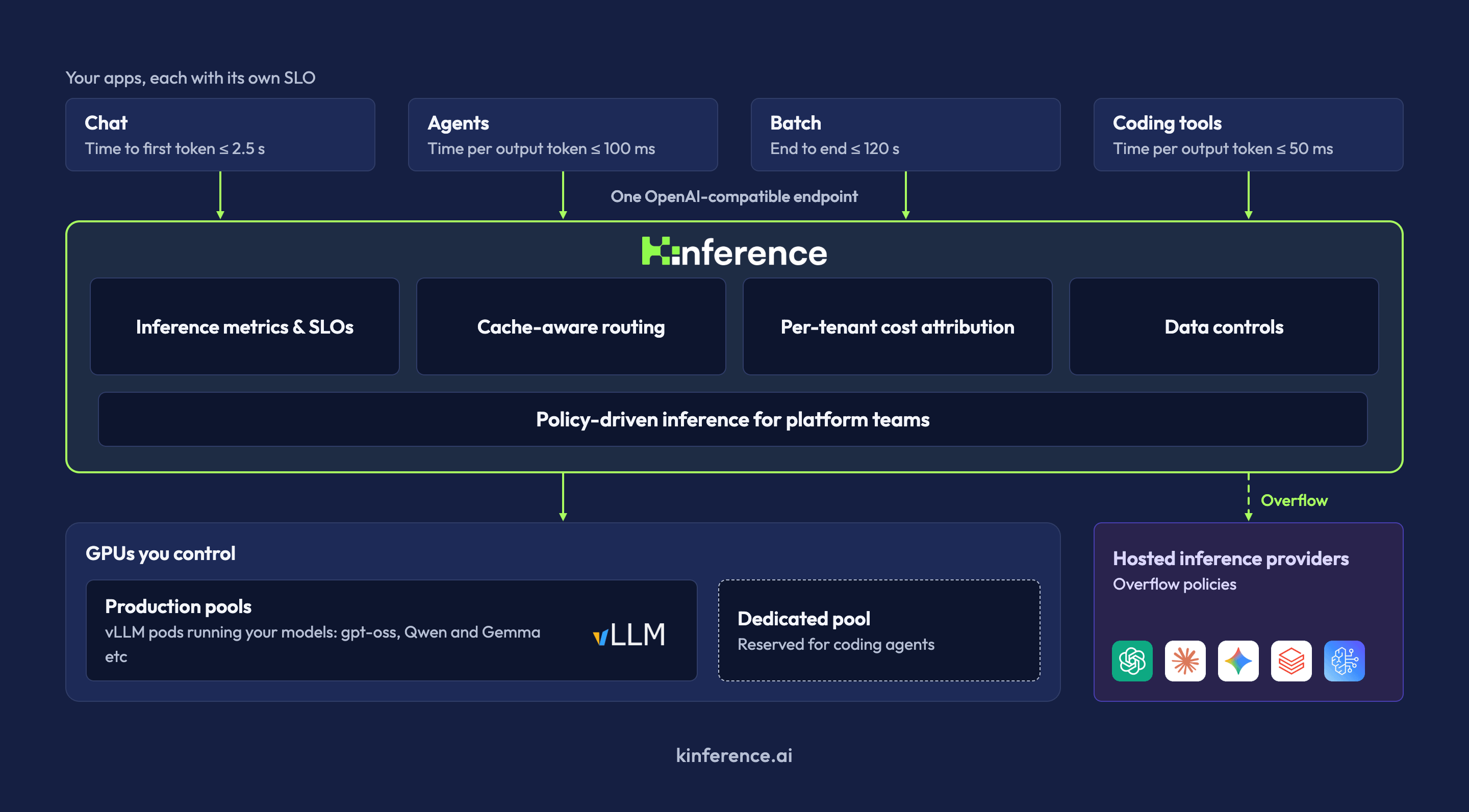
Kinference can be paired with your existing stack. Like an LLM gateway, using Kinference is simply a matter of pointing inference clients to its HTTP endpoint and sending OpenAI or Anthropic-compatible inference traffic there.
If you need to serve a heterogeneous, evolving set of models running on a heterogeneous, evolving pool of GPUs, to a heterogenous, evolving set of clients each with varied and competing demands, and somehow keep everyone happy: Kinference is for you.
(And while Kinference does not use or require Linkerd, it can certainly pair with it!)
A policy-driven approach
Central to Kinference is the idea of inference policies. This concept did not seem to exist anywhere in the Kubernetes inference ecosystem, but is central to our platform-centric approach.
Inference policies give platform owners explicit control over exactly how inference is served, allowing them to balance tradeoffs across usage, performance, and priorities. The need for explicit policies became apparent as we observed our customers tackle questions like:
- How do we allow users to request not just specific model checkpoints (“Qwen 3.8 with 27B params and the FP8 quantization, please”) but broader classes of models, such as “any Qwen 3.8 model” or “whatever is good for coding”?
- How do we redirect “easy” inference requests to cheaper models, even if the user requested an expensive model? And how do we do that without sending the whole prompt history to a cold GPU and incurring a huge latency hit?
- How do we serve batch requests when the GPUs are idle, but reject them when the GPUs are busy with higher-priority work?
- When our GPUs reach saturation, how do we burst extra requests to a third-party inference provider instead of queueing them?
- How do we ensure that prompts with PII never leave our environment?
Answering each of these individually required custom logic for routing inference requests (and, often, for modifying the request bodies themselves!). Rather than build a set of one-off features, we built a policy layer in Kinference that can express them all—and many others as well.
With inference policies, platform owners can create explicit rules for how inference requests should be routed (or rejected) based on tenant, model requested, state of the underlying GPU pool, semantic classification of the prompts, and many other factors. These policies can go through human or agentic review; they can be committed to git; they can be linted and vetted; and they can be applied or rolled back independently.
We think this policy engine is critical for providing a true inference platform. See our Kinference policy docs for more.
Inference load balancing and performance
In addition to policies and a routing layer, Kinference provides inference-specific load balancing that takes into account signals like GPU queue sizes, historical performance, and the contents of the KV cache on the GPU. This KV-cache awareness, in particular, allows Kinference to send requests to the vLLM worker that will do the least work for that specific request—which not only means it will be the fastest, it will also be the most efficient use of the GPU.
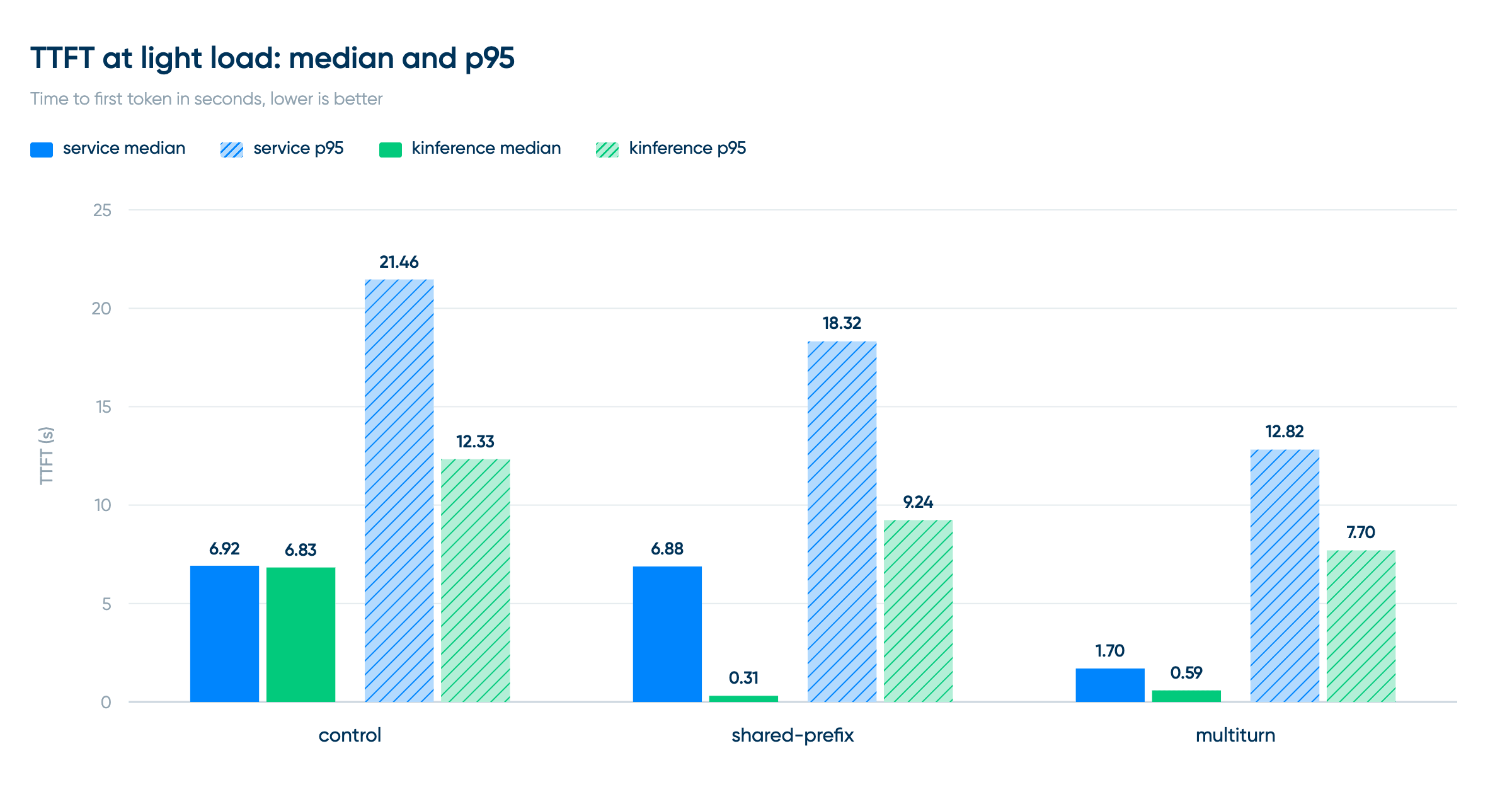
Modeling the KV cache content of the GPU can produce dramatic gains in performance for distributed inference. For example, in our public Kinference benchmarks, we showed that, when compared to standard Kubernetes load balancing (labeled “service” below), Kinference (labeled “kinference”) was able to cut median time-to-first-token (TTFT) by 95% and median end-to-end latency by 45% of requests on one workload type!
Platform owners and CFOs alike will be pleased, as performance is directly tied to capacity: given a fixed set of GPUs, the faster you can run inference on them, the more inference you can pack onto the same GPUs.
KV-cache awareness also plays a critical role in policies. Popular cost reduction strategies such as sending simpler prompts to cheaper models sound good on paper, but in practice they actually don’t work well since you’ll end up switching GPUs to target the cheaper model – and for multi-turn inference workloads like coding or chat, switching GPUs mid-conversation forces recomputing the entire conversation since it throws away the cached data that so much effort went into creating. By incorporating cache awareness into policies, Kinference provides a practical solution: platform owners can create policies that will send simple requests to the cheaper model — but only if that’s less work than sending them to the expensive model in the first place.
LLM-aware design and UX
We spent a lot of time ensuring that Kinference was usable by humans and agents alike. The reality is that as much as we all love writing lots of YAML by hand, LLMs are actually great at this task, and we expect the majority of configuration for Kinference will be primarily done by LLMs.
However, humans need to understand what Kinference is and does, and (at least, as of November 2026) LLMs are terrible at writing technical documentation. Thus, our strategy for Kinference was essentially “write docs for humans; write guardrails and feedback systems for agents”:
- We wrote the docs primarily by hand, with assistance from LLMs. A human should be able to read through everything on kinference.ai/docs/ and not be left scratching their head at convoluted LLM sentence structure and distracting linguistic quirks.
- We made sure the reference docs were comprehensive and described every field and its properties and limits, so the raw data was always available.
- We created a `kinfctl` CLI whose sole purpose right now is to allow agents to programmatically validate Kinference YAML without needing to ship it to a cluster.
- We gave every Kinference CRD a full suite of status messages, printer columns for `kubectl`, and any other affordance we could find to provide feedback to agents on its exact status once it was on the cluster.
We tested this ourselves by starting up common coding harnesses with fresh context windows, pointing them at the docs at kinference.ai, installing `kinfctl`, and asking the harness to write policies. Where we found the LLM getting confused or going down the wrong path, we updated the docs or added feedback to the tools until this was resolved. (We may automate this kind of testing in the future.)
You and your agents should both be happy with Kinference.
Inference metrics and SLOs
Finally, we would be remiss if we did not provide a comprehensive suite of inference-related metrics for platform owners to monitor, alert on, and build SLOs around. Kinference emits a wealth of information about what’s happening on the system, including not just its own health but:
- Tokens rates in and out, and histograms of input and output token sizes
- TTFT, ITL, and E2E latency histograms
- Uncached vs cached prompt tokens, for cost estimation
- Model usage, GPU saturation, etc
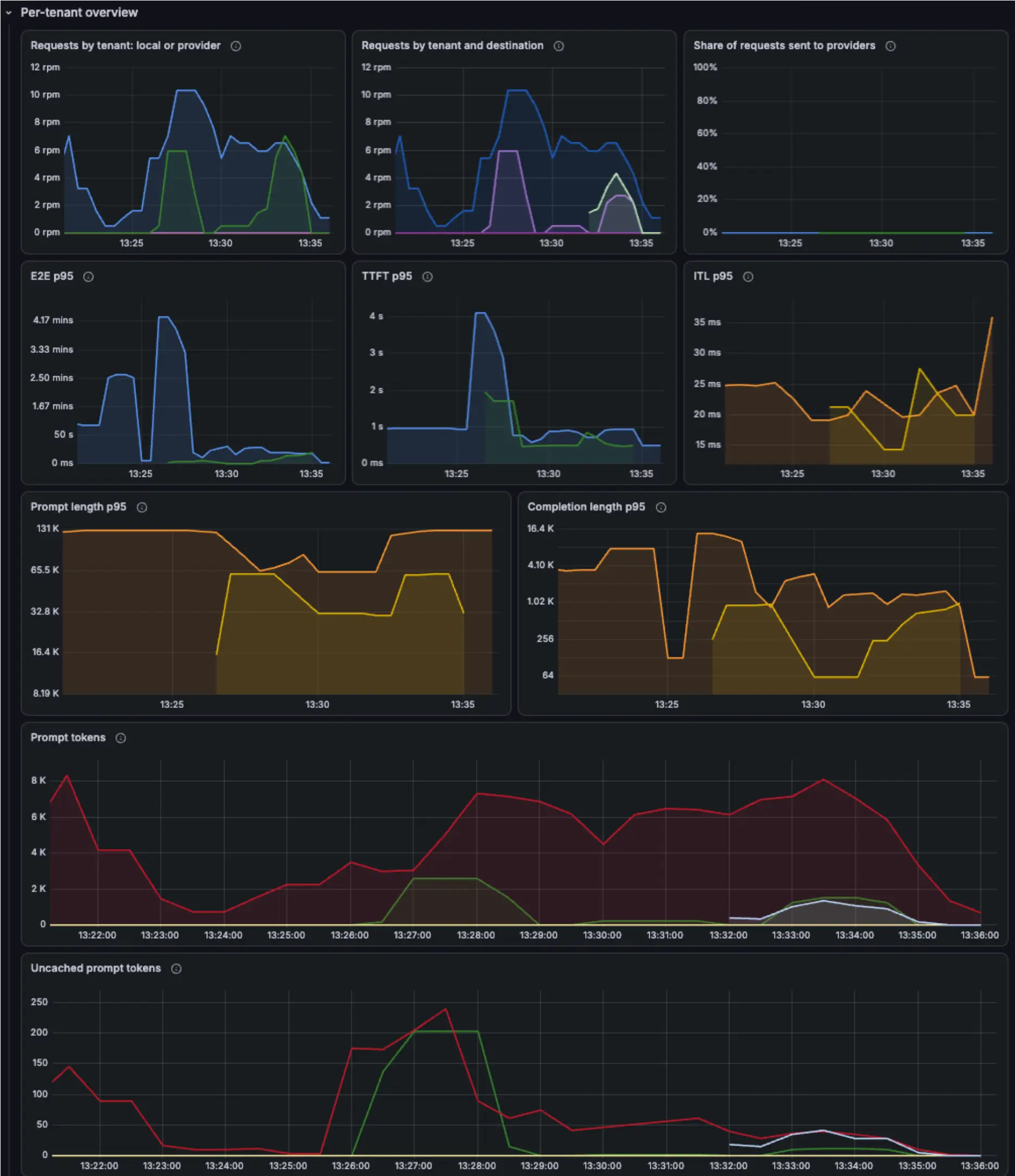
Almost every metric is also available per tenant, so you can track tenant usage, build specific SLOs around performance for specific tenants, and everything else you might need to ensure the platform you’re building is living up to its requirements.
Try it today
Our goal with Kinference is to enable every organization in the world to own their own intelligence with a secure, reliable, internal inference platform.
Kinference is fully open source under Apache v2. It’s available on GitHub and easy to get started in a few minutes. To see a demo of Kinference, and ask our team your questions, join us for our upcoming livestream, “Free tokens for everyone”, on Thursday, November 19th, at 9 AM PT.


