 LinkedIn


Self-hosted inference for agentic coding
Buoyant AI is an enterprise solution that serves coding agents using open-weight models on your own hardware. Developers keep their harnesses with no workflow changes for the models you already use. Each new model family and variant is configured ready to deploy into production as it arrives.
Works with
and other major coding harnesses
Tuned for
+ your next model
Coding agents on the latest open-weight models
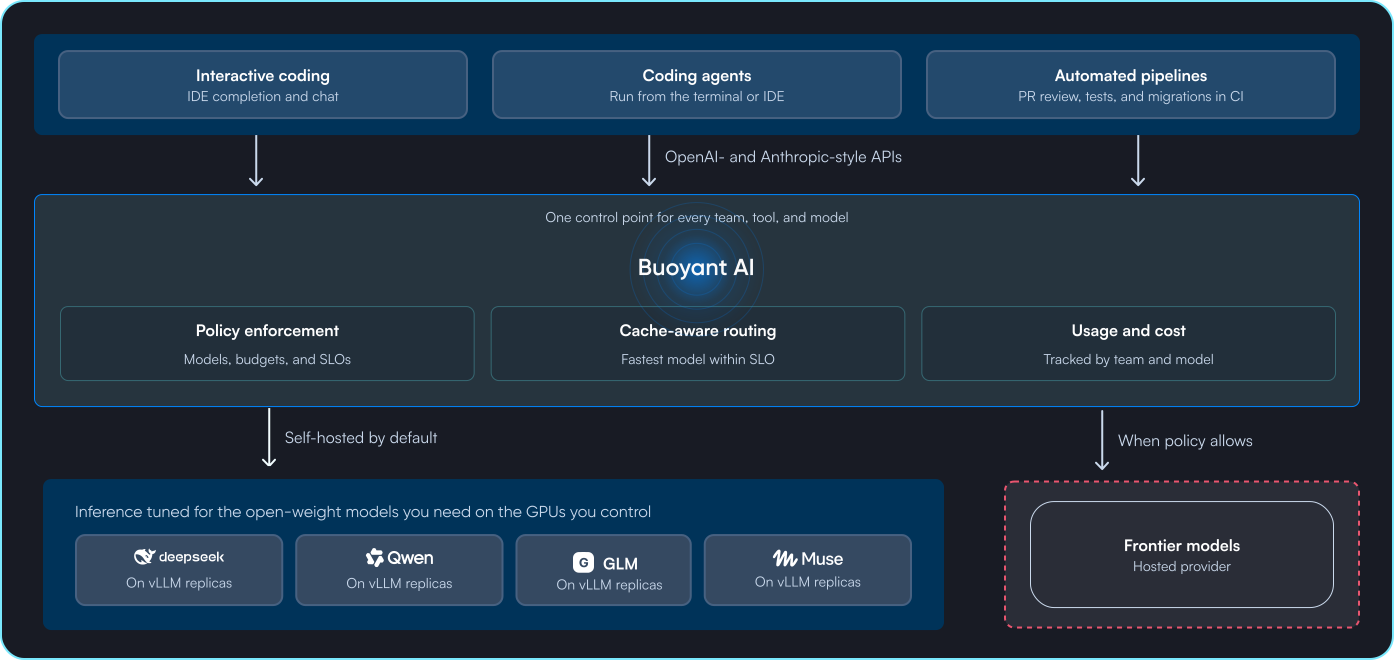
Developers keep Claude Code, Codex, OpenCode, or whichever harness they already use, and simply point it at your Buoyant AI inference platform. Their workflow stays the same, and policies come built-in for inference efficiency with every request served to an SLO.
✓ Latest open-weight models
✓ Full harness compatibility
✓ Frontier models when needed
✓ SLO-driven inference
Inference serving for coding agents under your control
Coding agents use models with declarative policy for usage, cost, and GPU efficiency. New model families and variants arrive preconfigured for your environment and deploy with the same policies, so agents adopt new models without friction.
✓ Controlled inference for models
✓ New models go live with policy
✓ Usage and cost policy per team
✓ Runs anywhere on Kubernetes

One platform to control inference cost, protect data, and serve every coding agent with the right model
Immediate token spend reduction
Save on inference costs and remove token accounting entirely by running coding agents on GPUs you control, where you pay for infrastructure, not tokens.
Compliance for data and IP management
Ease regulatory, compliance, and security concerns by removing external calls to third parties that may contain IP, customer data, or other confidential information.
Continuous quality improvements
Deliver an always-improving system that gets better as new open weight models are launched—which in some benchmarks already surpass the quality of frontier models.
Run coding agents on GPUs that stay fully utilized using inference tuned to how agents work and remove uncertainty
Connect your agents, define your policies so every coding task is served by the right model
Declarative policies decide how every request is handled, including which model serves it, the SLO it has to meet, and the team its cost belongs to. Requests stay on your GPUs by default. They go to a frontier provider only under conditions you set, such as GPU pool saturation, a specific tenant, or the characteristics of the request itself.
Buoyant AI is your business driver for self-hosted inference
Token cost is driving organizations to self-hosted models. Running Buoyant AI on your own workloads shows how self-hosted inference can meet your AI business goals as you build the infrastructure.
1
Profile your workloads
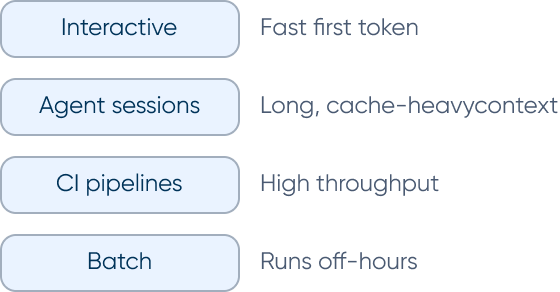
Map how your teams use coding agents, from IDE chat to CI pipelines, and profile each workload on the open-weight models you want to run.
An SLO profile for each team’s coding workloads, on the models you choose
2
Profile your workloads
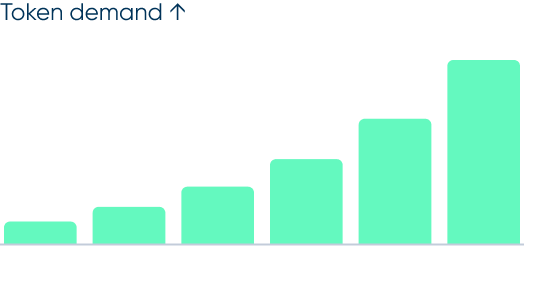
As token demand grows, define how each team’s requests are served: which models they use, the SLOs they need, and when work can overflow.
Declarative policies for every team, enforced against their SLOs
3
Pilot on your GPUs
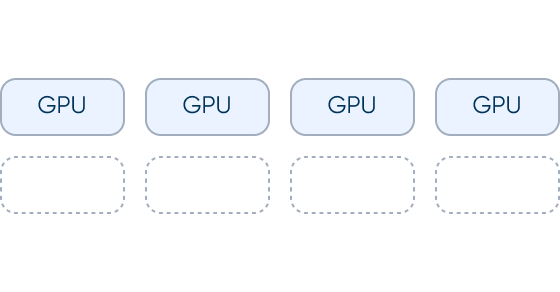
Run the coding agents on open-weight models on your own hardware and add new GPUs only as you need them.
Measured inference efficiency and GPU utilization
4
Prove the cost per token
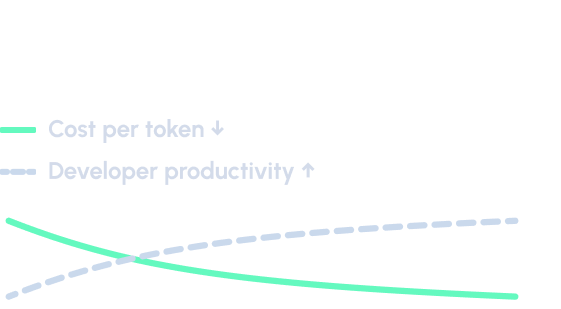
Compare GPU cost, performance, and developer output against hosted token spend.
The business case with cost per token and SLOs that justifies new hardware
Frequently asked questions
What is Buoyant AI?

Buoyant AI is a self-hosted inference solution for coding agents. It runs open-weight models on your own GPUs as a standard Kubernetes deployment, on-premises, on bare metal, or in private or hybrid cloud, and it's built on the open source vLLM and Kinference projects.
Do developers need to change their coding agents to use Buoyant AI?
No. Buoyant AI exposes OpenAI- and Anthropic-style APIs, so tools like Claude Code, Codex, and OpenCode point at your own endpoint instead of a hosted provider. Developers keep the same tools and workflows they use today.
Which open-weight models does Buoyant AI support?
We ship preconfigured deployments for models including Qwen, DeepSeek, Kimi, GLM, MiniMax, gpt-oss, Mistral, Gemma, Llama, and Muse. New models are tuned for coding agents and your hardware within days of vLLM support.
Can Buoyant AI send requests to frontier models?
Yes, when your policy allows it. Requests stay on your GPUs by default, and declarative policies can send them to a frontier provider under conditions you set, such as GPU pool saturation, a specific team, or characteristics of the request.
How is Buoyant AI different from running vLLM yourself?
vLLM serves the models. Buoyant AI adds what a platform team needs around it, including declarative policies for model access and SLOs, cache-aware routing, usage and cost tracking by team, and preconfigured deployments for new models.
How is Buoyant AI different from Kinference?
Kinference is our open source inference serving platform for Kubernetes, with inference-native policies. Buoyant AI builds on it for coding agents, adding preconfigured open-weight models tuned for your hardware, per-team usage and cost tracking you fully control.