 LinkedIn



Self-hosted inference for agentic coding
Buoyant AI moves agentic coding off per-token APIs and onto open-weight models running on GPUs you control, with no changes to how your developers work.
Buoyant AI runs as a standard deployment on any GPU that vLLM supports

Developer teams use open-weight models that are tuned for agentic coding and for your hardware
Harnesses use policy-driven inference so token cost falls as productivity rises
Tokens for productivity not cost
Free developer teams to run Claude Code, Codex, or OpenCode without per-token costs

Access to the most powerful models
The latest open-weight models, tuned for agentic coding and tailored for your specific hardware.

Tokens for visibility, not restriction
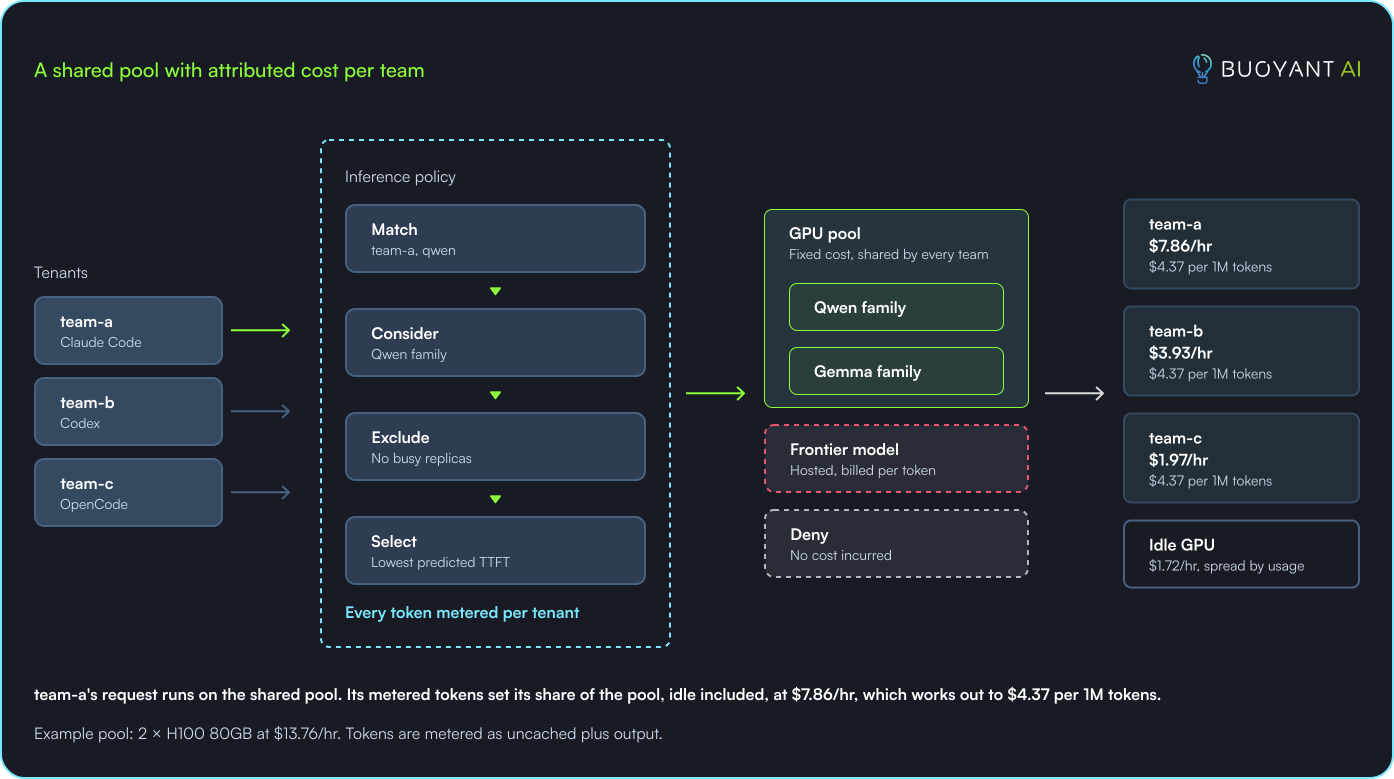
Token use is tracked per tenant, so your team uses the models it needs and removes restrictions defined by the amount of tokens you can spend.

Frontier models access when needed
Send inference requests to frontier models or other third-party providers when productivity requires it with no changes to your harness.
Policy-driven agentic inference on infrastructure the platform team controls from the prompt to the pod

Declarative inference policies.
Inference infrastructure with declarative policies that determine exactly how every inference request is handled.

SLOs tracked per team and replica
Set the performance coding agents need, and the platform manages the dedicated pool to meet it.

Hosted model serving by policy
Use hosted providers and frontier models when conditions apply such as GPU pool saturation, specific tenant request, or the characteristics of the prompt itself.
Buoyant AI is your platform solution for self-hosted inference designed specifically for enterprise agentic coding
Serve your coding agents using the latest open weight models on self-hosted infrastructure
The problem. Coding agents resend the same files on almost every request, and hosted providers bill each of those tokens. Inference activity directly impacts token volume and cost. The work that ships comes witha token cost that cannot be controlled or predicted up front. Inference cost efficiency is separated from developer productivity.
Buoyant AI
Run Claude Code, Codex, and OpenCode on open-weight models, on GPUs you already own, with no workflow changes. Declarative policies control how each request is served: which model in a family handles it, and whether it should go to a frontier model. Every token is attributed to the team that used it, so inference spend maps directly to development output.
Cut hosted inference spend and start measuring tokens as productivity
Frequently asked questions
Do developers need to change their coding assistant?

No. Any coding assistant or agent that calls an OpenAI-compatible API points at the endpoint your platform team publishes, and Kinference handles routing from there.
Which models can we run?
Any open-weight model you serve with vLLM, such as Qwen, GLM or Gemma. Model aliases give teams short, stable names, so you can swap the model behind a name without changing anyone’s config.
Why does cache-aware routing matter for coding?
Coding agents resend the same files and instructions on almost every request. Sending each request to the replica that already holds that context skips the repeated prefill, so first tokens arrive sooner and GPUs do less work.
What happens when the developer pool is full?
Your policy decides. Requests can go to another local replica, to a lighter model for simple prompts, or to a hosted provider, but only if that team’s config allows it.
Will self-hosting always cost less than a hosted API?
It depends on how well your GPUs are used. Kinference helps by raising cache hits and reporting token usage per team, so you can see what each team’s inference really costs.
What is Kinference?
Yes. Kinference is open source, with professional services from Buoyant for teams that want help with a production rollout. See the Kinference page at kinference.ai