


BEL Dashboard 1.0: An OSCAL Compliance API, Production-Ready Live Calls, and Kubernetes Authentication


November 18, 2026
We’re excited to announce the v1.0.0 release of the Buoyant Enterprise for Linkerd (BEL) dashboard (previously the Linkerd dashboard). The BEL dashboard is an on-prem, self-hosted dashboard that gives BEL users instant visibility into Layer 7 golden metrics and the real-time encryption status of each connection in the cluster. This release adds 3 new capabilities:
- An API that reports the real-time encryption status of every connection in your mesh as OSCAL-formatted JSON to enable the automated compliance checks that FedRAMP 20x requires for Class C and Class D services
- Live Calls, a hardened version of Linkerd’s Tap feature that’s safe to run in production, which enables real-time debugging and traffic insights
- Authentication enabled by default on the dashboard UI and APIs to improve overall security posture using familiar tools
OSCAL API for automated FedRAMP compliance
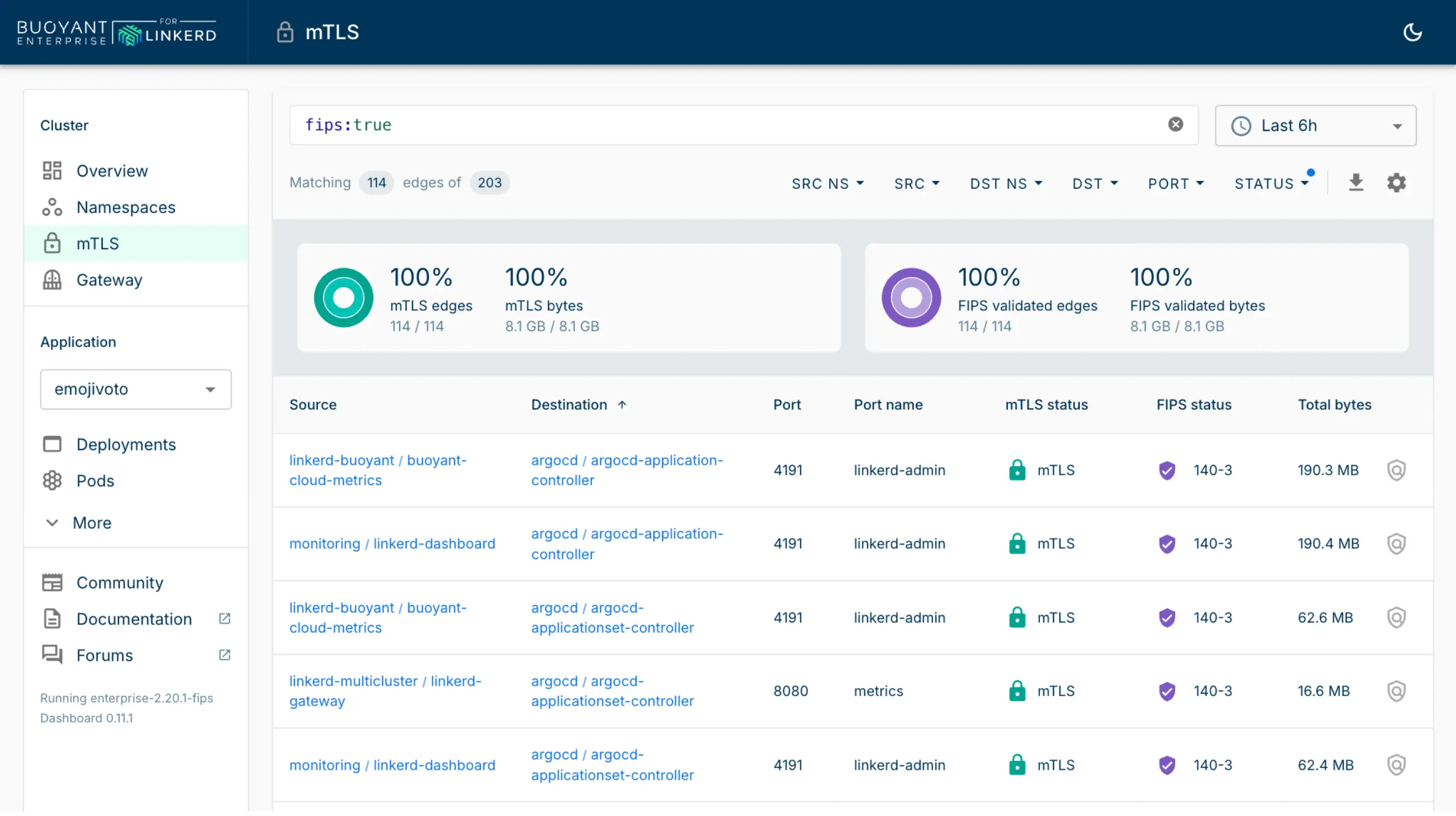
In addition to the existing real-time FIPS view, the BEL dashboard now has a new endpoint, /api/oscal/assessment-results, that returns real-time mTLS and FIPS status for every connection in your mesh as an OSCAL 1.2.3 assessment results document in JSON format. Your governance, risk, and compliance (GRC) platform can send this information directly to FedRAMP 20x automated compliance checks.
Just like our FIPS dashboard view, the data comes directly from BEL’s micro-proxies, so the output is based on actual traffic and encryption modules on both the source and the destination. For every workload, the API tracks whether its connections over the last 24 hours were encrypted per NIST SP 800-53 control SC-8, and whether its proxy used a FIPS-validated cryptographic module. Each result is tagged with the matching FedRAMP 20x Key Security Indicator, so a GRC tool can file it under the right requirement.
Why did we build it?
The Open Security Controls Assessment Language (OSCAL) is NIST’s machine-readable format for security documentation. It lets control catalogs, system security plans, assessment results, and remediation plans live in structured data (JSON, XML, or YAML) instead of Word and Excel. The primary goal is to speed up assessments and enable continuous monitoring.
Under the Consolidated Rules for 2026, FedRAMP requires certification data in machine-readable formats with documented programmatic access. Word and Excel will soon be retired as acceptable formats. On the FedRAMP 20x path, Class C and Class D services (roughly the Moderate and High baselines) must persistently validate every Key Security Indicator with at least 2 and 4 automated methods per indicator, respectively. That’s a big shift from the annual audits compliance teams are used to.
Proving FIPS-validated encryption for data in transit can be challenging, especially if you have thousands of connections that change every time a pod restarts. BEL was already the only service mesh that provided FIPS evidence in a human-readable interface and an on-demand CSV export. The OSCAL API now provides the same detailed evidence in a format your compliance software can read.
Live Calls
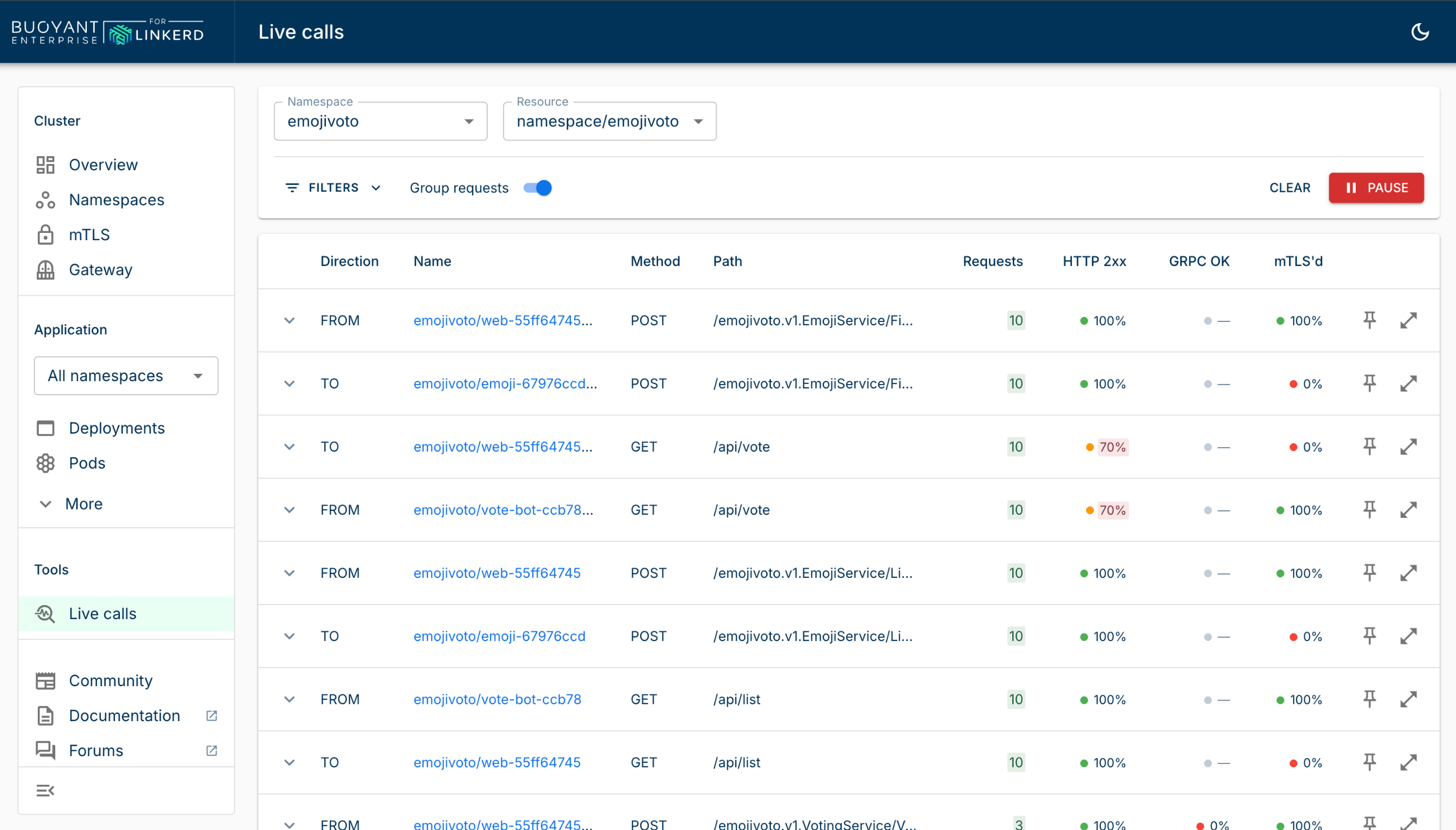
By popular demand, the BEL dashboard now includes support for Live Calls (previously known as Tap among users of Linkerd’s older Viz dashboard). Users can pick a workload and watch requests as they happen. Grouping Live Calls by route easily provides route-specific metrics like the method, path, request count, and success rate; alternately, Live Calls can show individual requests in real time as a powerful debugging technique.
Most importantly, we’ve hardened the capability for production use and added guardrails to prevent unwanted waste. Observed calls are rate-limited, and you can cap the number of concurrent requests. Each session has a maximum lifetime and a maximum event count, so observation stops on its own instead of streaming indefinitely from a forgotten browser tab.
Why did we build it?
Until now, the functionality provided by Live Calls was available only as the Tap function of the open-source Linkerd Viz extension. The Linkerd community, including our enterprise customers, have asked for a hardened, production-ready version of Tap. With the Live Calls view, we’re delivering on that request.
For platform teams and SREs, streaming live requests to debug a failing route or confirm a new service is meshed can save precious time. In an audit, showing a live request going over mTLS can be faster - and clearer - than sharing a config file.
Dashboard Authentication
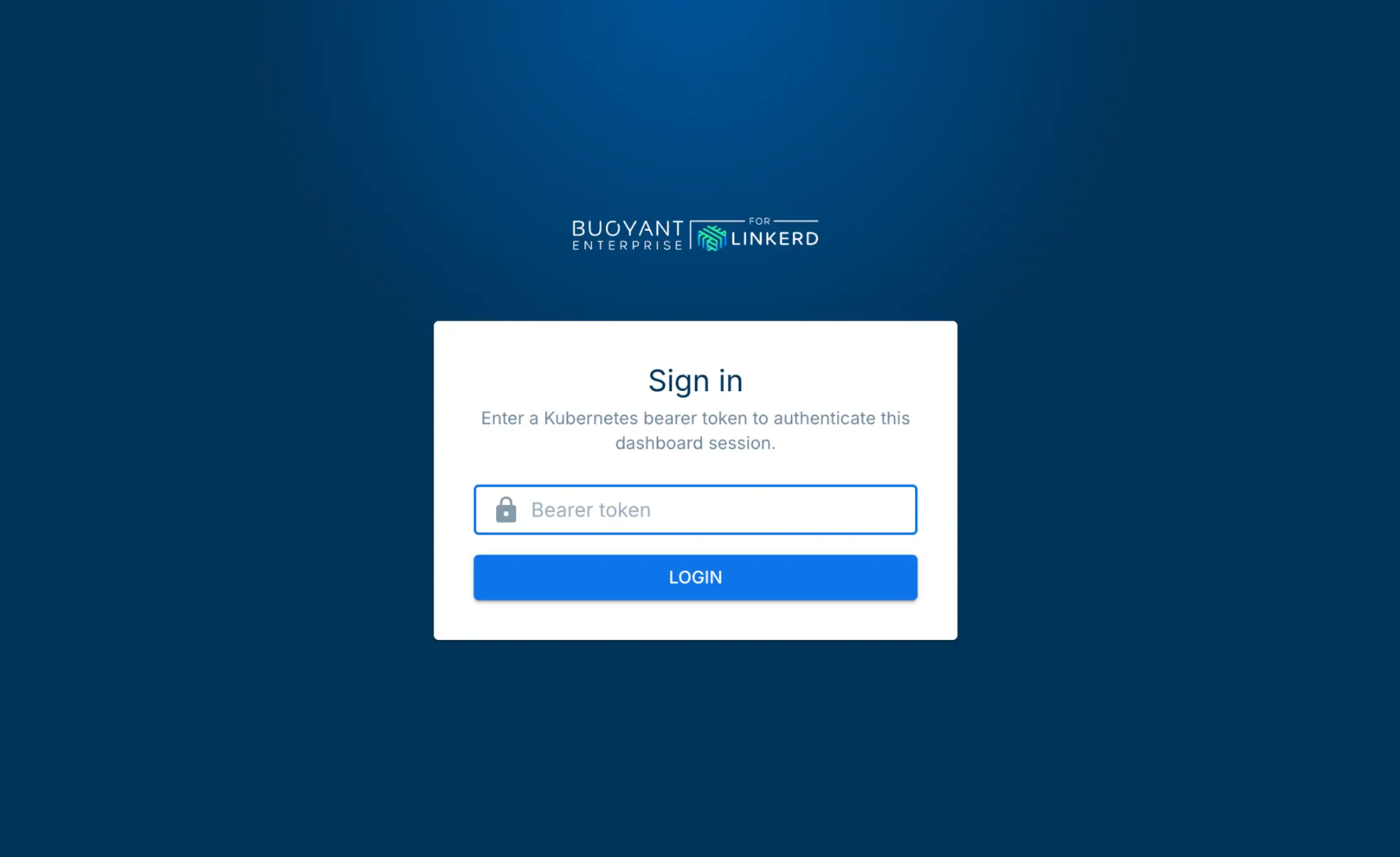
The dashboard UI (including Live Calls) now requires authentication by default using a Kubernetes bearer token. This is the same sign-in model the Kubernetes Dashboard uses, so BEL users can issue, scope, and revoke BEL dashboard access with familiar identity tooling.
The OSCAL API uses Linkerd authorization policy to restrict access. Clients can only use this endpoint if they are meshed, and if their ServiceAccount is listed in oscal.authorizedServiceAccounts when you set up the dashboard. By default, this list is empty, so all requests to the OSCAL API endpoint are denied.
Why did we build it?
Earlier versions of the BEL dashboard did not include built-in authentication and required users to provide it using an API gateway or an authentication proxy. This complicated safe deployments and made it more likely to see the dashboard deployed without authentication at all.
As the BEL dashboard is increasingly being used for compliance evidence and now includes a live view of production requests, our team at Buoyant felt it necessary to strengthen the security posture. Tying access to Kubernetes identity allows your team to answer “Who can see this?” with confidence, in a way that matches the rest of your cluster.
Getting started with the BEL dashboard
BEL dashboard 1.0.0 is available now for BEL customers and is installed from the Helm chart at oci://ghcr.io/buoyantio/charts/linkerd-dashboard. The release notes cover the upgrade, bearer token setup, and Live Calls configuration. Please connect with your Customer Success team member for additional information.
If your compliance team is preparing for a FedRAMP assessment, send them a sample of the OSCAL output and have them map it against their control inventory. Contact us for more information.


