LinkedIn


Evaluating a Service Mesh for a Large Multi-Cluster Estate: A VP Engineering's Checklist
Jun 2026
Somewhere in your organization, a platform team is about to recommend a service mesh, and you're the person who has to approve a decision your company will live with for 5 years or more. With 82% of container-using organizations now running Kubernetes in production per the CNCF's 2025 survey, the mesh layer is infrastructure in the load-bearing sense: it touches every request between every service.
The decision also has a long memory. Reversing a mesh choice means re-touching the connectivity, security posture, and observability of everything you run, which is why the evaluation deserves more rigor than the category usually gets, and why "the team saw a good conference talk" is not an evaluation.
"Enterprise-grade" gets asserted in this category far more often than it gets defined. Here's a definition you can hold any vendor to, in 6 checks, with numbers where numbers exist. We make Buoyant Enterprise for Linkerd (BEL), so you know where we stand; every claim below is linked so you can verify it without trusting us.
Check 1: the day-2 operating cost, in headcount
The mesh's sticker price is rarely the expensive part. The expensive part is the fraction of your platform team's attention it consumes, forever: upgrades, version compatibility, configuration sprawl, and incident debugging.
Make the evaluation concrete. Have the team document, for each candidate: the number of components operated (control plane parts and every data plane proxy type), the upgrade procedure across all of them, and the CRD count your engineers must understand to reason about traffic. Then ask the only question that compounds: which of these grows when we adopt more features?
Linkerd's design goal, stated for years and visible in its architecture, is minimal operational surface: 1 proxy type for L4 and L7, a small control plane, and feature adoption that changes configuration rather than topology. Istio in ambient mode runs a per-node L4 tier plus per-namespace Envoy waypoints once L7 features turn on; the architecture is documented here and your team should walk it before estimating staffing, not after.
Check 2: security posture you can show an auditor
Four artifacts to request from any mesh vendor, all of which exist publicly for Linkerd:
- Default security stance. Linkerd ships mTLS with workload identity on by default, not as a configuration project. (docs)
- Independent audit. The Linkerd 2024 security audit is public. A data plane small enough to audit meaningfully is itself a security property: less code on the request path is less code that can betray you.
- Supply chain evidence. Stable BEL images ship with SBOM and SLSA provenance attestations, signed, as OCI 1.1 referrers. When software-supply-chain questions reach your desk via a customer security questionnaire, this is the evidence that answers them.
- Cryptographic forward posture. Linkerd 2.19 enabled post-quantum key exchange (ML-KEM-768) by default for meshed traffic, ahead of NIST's transition guidance (IR 8547), which deprecates RSA-2048 and ECC P-256 by 2030. Your mesh either has a PQC answer in 2026 or it becomes a 2029 migration project.
Check 3: performance, because performance is cost
At enterprise scale, proxy overhead is a line on the cloud bill and a tax on every SLO. Two public data points worth your team's attention:
- In 2025 benchmarks with published methodology and raw data (GKE, wrk2, L7 enabled on both meshes), Linkerd led Istio at every load level tested: by 22.83ms at p99 under 200 RPS and 163ms at p99 under 2000 RPS against sidecar Istio, with a consistent lead over ambient mode as well. Disclosure your team should know: the author is a Linkerd Ambassador, the traffic was North-South against a demo app, and the raw data is public, which is exactly what makes the numbers reproducible rather than promotional.
- In Buoyant's published comparison, Istio's Envoy proxies consumed several times the memory and CPU of Linkerd's Rust microproxies, with the control plane gap larger still. Vendor-published, so have your team validate it; the methodology is disclosed for exactly that purpose.
The correct executive takeaway is narrower than "Linkerd is faster": the data plane's efficiency compounds across every meshed pod you run, and the benchmarks are reproducible, so 2 weeks of POC gives you your own numbers. Insist on that POC for any candidate whose published numbers can't be reproduced.
Check 3.5: the hybrid estate test
You may still encounter the claim that Linkerd is "Kubernetes-only" and therefore unsuitable for hybrid estates. It's been false since February 2024, and since most large estates are hybrid, you should know the current facts before they're asserted at you in a vendor meeting.
Linkerd 2.15 shipped mesh expansion: the same Rust microproxy deployed on VMs or bare metal, joined to your existing control plane, with workload identity via SPIFFE/SPIRE. Off-cluster workloads get the same default mTLS, the same route-level authorization policy, and the same golden metrics as meshed pods, and a single Kubernetes Service can load-balance across pods and VMs together. For an estate mid-migration, that last property converts every "big-bang cutover" on your roadmap into a gradual traffic shift with per-endpoint metrics watching it happen.
For the strategy conversation this matters twice. Once for risk: the legacy workloads that worry your auditors most are precisely the ones a Kubernetes-only security boundary excludes. And once for sequencing: a mesh that spans both worlds means your zero-trust program doesn't have to wait for your containerization program to finish, and those are usually different budget years.
The one real boundary, stated plainly: Linkerd's control plane runs on Kubernetes. An organization with no Kubernetes at all has no Linkerd story, and per the CNCF's production numbers, almost nobody reading this is that organization.
Check 4: scale claims with names attached
"Runs at enterprise scale" should come with referenceable evidence, so here's ours, with names and numbers. Xbox Cloud Gaming secures 22,000 pods across 26+ clusters in multiple Azure regions with Linkerd. Imagine Learning cut compute requirements by more than 80%, reduced mesh-related CVEs by 97%, and projects at least a 40% cut in cross-zone data transfer costs. IntelliGRC expedited FedRAMP authorization on BEL's FIPS-validated modules and grew monthly recurring revenue more than 4x afterward. The fuller set, including Zscaler's FedRAMP ATO journey and loveholidays' MTTD reduction, is on the case studies page, alongside the community adopters list. Adopters operate Linkerd on hundreds to thousands of clusters managed via GitOps, which is precisely the deployment shape the 2.17 and 2.18 multicluster work (federated services, fully declarative cluster links) was built to serve. The mesh also extends beyond Kubernetes to VM and bare-metal workloads, which matters if your estate is hybrid, and most large estates are.
Ask every vendor for 3 reference customers whose cluster count and regulatory profile resemble yours. Then have your engineers run the reference calls with operational questions, because reference calls run by salespeople produce testimonials and reference calls run by engineers produce data:
- How many engineers operate the mesh, as a fraction of their time, across how many clusters?
- What was your last mesh-related page, and what did it take to resolve?
- What does a mesh upgrade cost you in hours, and when did one last go wrong
- What did the mesh's resource overhead do to your node sizing or your cloud bill?
- Knowing everything you know, would you pick it again today, and what almost changed your mind?
A vendor whose references answer those questions comfortably is telling you something; so is a vendor who can't produce references that will.
Check 5: vendor model and exit path
Foundational infrastructure deserves the uncomfortable questions.
Who maintains it, and how are they paid? Linkerd is a CNCF graduated project, Apache 2.0, with development funded primarily by Buoyant through BEL subscriptions, a model that's publicly documented and producing results. You can audit the incentive structure, which is more than most infrastructure lets you do. (The fuller licensing story, including the 2024 controversy, is worth your time; we wrote it up honestly in our companion piece, "How Linkerd Licensing Actually Works," and Buoyant's clarifications post is the primary source.)
What's the exit? All source is Apache 2.0 and free edge releases ship weekly, so the worst case is "run and support it ourselves or migrate," the same worst case as any open source infrastructure, with no closed protocol or config format holding your traffic hostage.
What does support actually mean? With BEL, an SLA with the engineers who write the code. Price that against the alternative: senior platform engineers self-supporting a from-source build of any mesh during a Sev1.
Check 6: the honest fit assessment
Where Istio is the better answer, so you can trust the rest of this page: if your organization needs to run its own code inside the proxy via WASM plugins, or has standardized on Envoy as a competency and wants one proxy ecosystem everywhere, Istio fits those requirements and Linkerd doesn't try to. Most enterprises don't have those requirements; the ones that do, know.
Everything else the "Istio for large enterprise" framing implies (VM support, multi-cluster at scale, compliance posture, performance under production load) is covered above, with links, and in several cases the Linkerd evidence is stronger and more recent than the framing assumes.
What the scorecard looks like when it's done
A decision memo that survives board and audit scrutiny has a particular shape, and it's worth specifying up front so the POC produces it. For each candidate: component count operated (day 1 and after planned feature adoption), upgrade runbook as actually executed during the POC with hours logged, p99 latency and proxy resource consumption on your representative workload at your production request rates, security evidence collected (default posture, audit reports, supply chain attestations, crypto roadmap), 3 reference customers contacted with notes, support terms with SLA and escalation path, and the exit cost estimate.
Two failure modes to ban in advance, because they're how mesh decisions go wrong. First, the feature-matrix decision: counting checkboxes instead of weighing the 6 or 7 capabilities you'll really use, which systematically favors the most complex candidate. Second, the conference-keynote decision: adopting what the most exciting talk ran, instead of what your 4-person platform team can operate alongside everything else they own. The checklist exists to make the boring, defensible decision the easy one to document.
It's also worth pricing the null hypothesis: no mesh, or mTLS via some narrower mechanism. A mesh earns its place when you need several of: universal encryption with identity, uniform golden metrics, traffic policy, and multicluster routing, at a price (in headcount, not just dollars) below assembling them piecemeal. Linkerd's pitch to the budget owner is that it minimizes that headcount price, and the checks above exist so it can prove that claim against a live alternative on your workloads rather than assert it on a page.
What to do with this
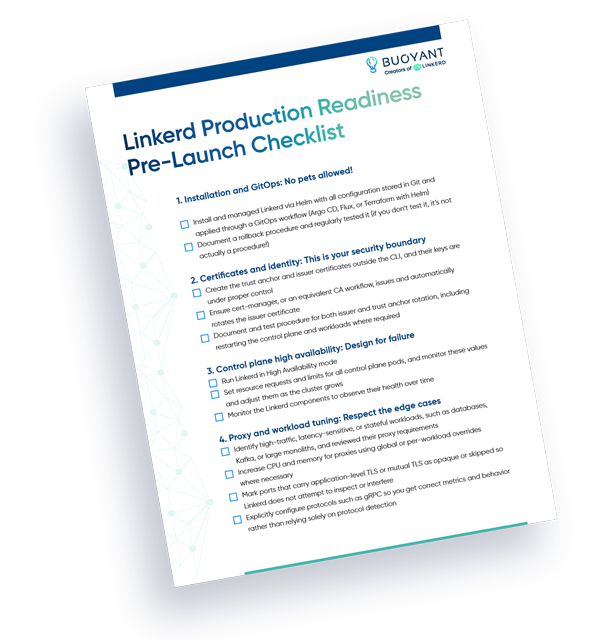
Give this checklist to your platform lead as the POC scorecard: 2 candidate meshes, 2 weeks, your workloads, all 6 checks scored with evidence. The output is a decision memo your board, your auditors, and your future self can all read.
A note on who should run it: the engineers who'll carry the pager, not a tiger team or a vendor's professional services. The point of checks 1 through 4 is to surface the operational reality your specific team will live with, and that reality varies with the team. A mesh that a 20-person platform organization operates comfortably can sink a 4-person one, and the only people who can measure that are the 4.
Budget the POC honestly too: 2 engineers for 2 weeks is a real cost, and it's cheap insurance on a 5-year infrastructure decision. Buying the evaluation up front is the cheapest this decision will ever be.
If you want the BEL side of that evaluation set up properly, contact us; the under-50-employee tier is free, and POC support is what it's for. We'll also tell you, in writing, if check 6 says you should run Istio. A mesh vendor you can't get a straight answer from before the contract is signed won't improve afterward.
Sources: CNCF 2025 annual survey announcement · Linkerd vs Ambient Mesh: 2025 benchmarks · Buoyant: Linkerd vs Istio · Linkerd adopters · Linkerd 2024 security audit · Linkerd 2.19 announcement · NIST PQC standards · Istio ambient architecture · Istio WASM concepts · Buoyant case studies · Xbox · Imagine Learning · IntelliGRC · Zscaler · loveholidays
Frequently asked questions
How should an engineering leader evaluate a service mesh?
Run a 2-week POC scored on 6 checks: day-2 operating cost in headcount, security evidence an auditor accepts, performance on your workloads, scale references with names, vendor model and exit path, and an honest fit assessment against your real requirements.
Is Linkerd suitable for large enterprises?
Yes. Adopters run it on hundreds to thousands of clusters via GitOps, it extends to VM and bare-metal workloads, it leads current published benchmarks at p99, and it ships a public security audit, SBOM/SLSA attestations, and FIPS 140-3 builds through BEL.
Is Linkerd Kubernetes-only?
No. Since Linkerd 2.15 (February 2024), mesh expansion runs the same proxy on VMs and bare metal with the same mTLS, policy, and metrics. The one real boundary: the control plane runs on Kubernetes, so a no-Kubernetes org has no Linkerd story.
How does service mesh performance affect cloud cost?
Proxy overhead compounds across every meshed pod. In 2025 benchmarks with published methodology, Linkerd's data plane led Istio in both modes at p99 at every load tested, and lighter proxies mean smaller nodes and a smaller bill at fleet scale.
When is Istio a better fit than Linkerd?
When you need to run your own code inside the proxy via WASM plugins, or you've standardized on Envoy as an organizational competency. Most enterprises don't have those requirements; the ones that do, know.